
Objectifs et philosophie de la Chaire « Expérience client »

L’idée de la chaire Expérience Client repose sur un constat simple. Il n’existe pas d’entreprise qui ne délivre d’expérience à ses clients quel que soit son secteur d’activité. Mais pour autant toutes les entreprises ne mettent pas à profit la perspective expérientielle pour construire des avantages concurrentiels. L’idée à l’origine de la chaire est par conséquent de réunir des partenaires opérant dans des secteurs différents, autour de la thématique de l’expérience client en croisant les perspectives managériales et académique.
Research Chair in Digital Affairs
The Chair in Digital Business uses cutting-edge methodologies to study the implications and consequences of emerging technologies such as robotics, artificial intelligence, participatory innovation platforms and other digital technologies, on the future of the workplace. The research activities of the chair are conducted by experts in their fields, in cooperation with business leaders and in fact, are relevant, both in practice and academically.
La légitimité des marques régions aux yeux de leurs habitants

Les territoires commencent à adopter des stratégies de marquage inspirées du marketing commercial. Mais comment les parties-prenantes perçoivent-elles ce genre de pratiques ? Sur la base d’une enquête menées auprès de résidents français, nous analysons la légitimité publicitaire d’une marque territoire et son impact sur l’efficacité des communications marketing dans le contexte d’une marque région. Les résultats confirment que la légitimité publicitaire est un médiateur de la relation entre l’exposition à une publicité et son efficacité.
Chaire « Internet des Objets »

La Chaire IoT (Internet of Things) a pour vocation de permettre une meilleure compréhension des enjeux de création de valeur liés à l’évolution digitale et au développement des objets connectés.
Effets des avertissements visuels menaçants apposés sur les paquets de cigarettes

Question de recherche – Cette étude a pour objectif d’examiner le rôle de deux facteurs structurels – le niveau de menace de l’avertissement sanitaire disposé sur le paquet de cigarette et la taille de l’avertissement – ainsi que deux facteurs contextuels – l’exposition répétée et le paquet neutre – sur les réponses émotionnelles et comportementales de fumeurs.
Méthodologie – Un design expérimental 2 (niveau de menace: modérée vs élevée) x 2 (couverture: 40 vs 75%) x 2 (type de conditionnement: paquet neutre vs paquet classique) a été développé. Les sujets ont été exposés à trois reprises à 8 paquets de cigarettes comprenant ces avertissements. Des mesures psychophysiologiques des émotions ont été effectuées, ainsi que des mesures déclaratives à l’aide d’un questionnaire.
Résultats – Les résultats indiquent que le niveau de menace de l’avertissement est le facteur structurel le plus efficace pour influencer les réactions des fumeurs, alors que la taille de l’avertissement a un impact très faible. En outre, les émotions négatives, ainsi que l’attitude envers la marque de tabac, diminuent après la deuxième exposition, mais restent stables lors de la troisième exposition. Toutefois, la répétition n’a aucun effet sur la valence émotionnelle, l’activation subjective, sur l’intention de cesser de fumer ou de réduire la consommation de cigarettes.
Enfin, le paquet neutre a un effet négatif sur l’attitude à l’égard des marques de tabac et ce même après trois expositions.
Implications sociales – Les résultats de cette étude sont susceptibles d’aider les décideurs gouvernementaux en santé publique à faire évoluer le contenu et le contexte de présentation des avertissements destinés à lutter contre le tabagisme.
Originalité – Pour la première fois dans ce contexte, les mesures psychophysiologiques et déclaratives ont été combinées afin de mesurer les réactions des fumeurs face aux avertissements dans le contexte d’une exposition répétée.
Purpose – This study aims to investigate the role of two structural factors – threat level depicted on fear messages and warning size – as well as two contextual factors – repeated exposure and type of packs – on pictorial and threatening tobacco warnings’ effectiveness.
Design/methodology/approach – A two (warning threat level: moderate vs high) x two (coverage: 40 vs 75 per cent) x two (packaging type: plain vs branded) within-subjects experiment was carried out. Subjects were exposed three times to pictorial and threatening tobacco warnings. Both self-report and psychophysiological measurements of emotion were used.
Findings – Results indicate that threat level is the most effective structural factor to influence smokers’ reactions, while warning size has very low impact. Furthermore, emotional arousal, fear and disgust, as well as attitude toward tobacco brand, decrease after the second exposure to pictorial and threatening tobacco warnings, but stay stable at the third exposure. However, there is no effect of repetition on the emotional valence component, arousal-subjective component, on intention of quitting or of reducing cigarette consumption.
Finally, there is a negative effect of plain packs on attitude toward tobacco brand over repeated exposures, but there is no effect of the type of packs on smokers’ emotions and intentions.
Social implications – Useful marketing social guidance, which might help government decision-makers increase the effectiveness of smoking
reduction measures, is offered.
Originality/value – For the first time in this context, psychophysiological and self-report measurements were combined to measure smokers’ reactions toward pictorial and threatening tobacco warnings in a repeated exposure study.
L’utilité des marques : possibilité, devoir ou chimère ?

Les marques ne se contentent pas de mettre en scène des produits et services pour les vendre plus souvent et plus cher. Ce sont des acteurs et des auteurs essentiels de la vie économique et culturelle qui agissent sur nos manières de penser, de dire et de faire. A ce titre se pose la question de leur capacité à changer la vie des individus et des sociétés. En évitant les écueils de l’angélisme et du cynisme, il s’agira de penser ce que peut être une marquéthique.
Detecting, Preventing, and Mitigating Online Firestorms in Brand Communities

Online brand communities create the risk of significant problems – negative electronic word of mouth (eWOM) that receives substantial support from other customers in a short period of time. Detecting, preventing and mitigating the virality of negative eWOM is a critical managerial priority, but most companies lack guidelines.
This study not only identifies the sources of such problems, but also details the appropriate sequences that companies should use when responding to them.
Specifically, the study reveals (1) how sender and relational aspects help detect potential problems in online brand communities, (2) how companies should adapt their responses to limit the virality of negative eWOM when issuing responses, and (3) how structured sequences of different responses across multiple enterprise messages mitigate the impact of this type of online problem.
« Influencer marketing » can be used to increase supermarket sales.
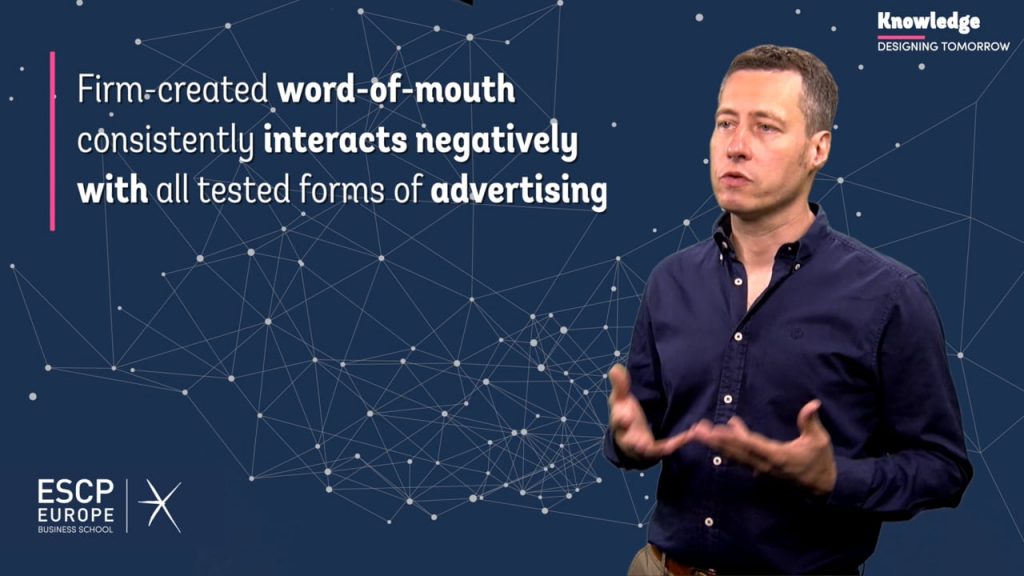
Michael Haenlein and his co-authors analyzed the use of customers as micro-influencers to drive sales of everyday consumer products.
For years, celebrities have represented brands and helped sell their products. Today, consumer packaged goods (CPG) manufacturers are also investing in word-of-mouth programs and encouraging customers to market their products. But do these programs really help increase sales of consumer products?
This is the question that Michael Haenlein, professor of marketing at ESCP Europe, tried to answer with Florian Dost, professor at the University of Lancaster, Ulrike Phieler, PhD student at the European Viadrina University, and Barak Libai, professor at the Arison School of Business, in an article they published in the Journal of Marketing and in a managerial version published by the American Marketing Association.
Empirical generalizations on the impact of stars on the economic success of films

Film industry experts are constantly debating whether the industry’s huge investments in movie stars are profitable. In order to make empirical generalizations, the authors (1) provide a meta-analysis of the relationship between the power of stars and the success of films and (2) analyze a complete dataset of this industry with n=1,545 films. Based on these two studies, four empirical generalizations emerge. First, when we ignore the effects of star selection, the impact of star power on box office revenues is strongly biased upwards. Second, the artistic star power (cf. commercial) is associated with significantly lower box office revenues. Third, on average, films with a commercial star (cf. without a commercial star) generate US$12.46 million in additional box office revenues. In contrast, artistic stardom does not result in a statistically significant increase in revenues. Fourth, commercially successful (artistic) stars have a statistically significant « multiplier effect » of 1.127 (1.083) on other characteristics that influence a film’s revenue.
Résistance du consommateur aux innovations dans le service à l’ére de l’Internet des Objets

L’internet des objets devrait être la prochaine phase de la révolution numérique qui va transformer la vie des consommateurs. Il soulève néanmoins des défis. Fondé sur le cadre théorique de Ram et Sheth (1989), ce travail tente de mieux comprendre les faceturs de résistance des consommateurs aux services intelligents en tant qu’innovation. À cette fin, notre recherche adopte un cadre intégratif combinant des barrières fonctionnelles, des barrières psychologiques et des barrières individuelles. Notre recherche enrichit la littérature existante en (1) adaptant le cadre théorique de Ram et Sheth (1989) à l’évolution des technologies numériques (barrières de vulnérabilité technologique), (2) en prenant en compte l’aspect idéologique de la résistance (barrières idéologiques), et (3 ) en prenant en compte les variables disposionnelles (barrières individuelles). En outre, il souligne le rôle clé du scepticisme à l’égard des appareils IoT en tant que médiateur entre les barrières de vulnérabilité technologique et les barrières individuelles, d’une part, et la résistance des consommateurs aux services intelligents, de l’autre.
The Internet of Things (IoT) is expected to be the next phase of the Internet revolution and to transform consumers’ service experience. It nevertheless raises challenges on innovation in services. Based on Ram and Sheth’s (1989) theoretical framework, this work attempts to provide a better understanding of the barriers that lead to consumers’ resistance to smart services as an innovation. To this end, our research adopts an integrative framework that combines functional barriers, psychological barriers, and individual barriers to explain consumer resistance to smart services. Structural equation modeling was used to test this theoretical framework. Our research enriches the existing literature by (1) adapting Ram and Sheth’s (1989) theoretical framework to the evolution of digital technologies (technological vulnerability barriers), (2) taking into account the ideological aspect of resistance (ideological barriers), and (3) considering dispositional variables (individual barriers). Moreover, it highlights the key role of skepticism toward IoT devices as a mediator between technological vulnerability barriers and individual barriers on the one hand and consumer resistance to smart services on the other.